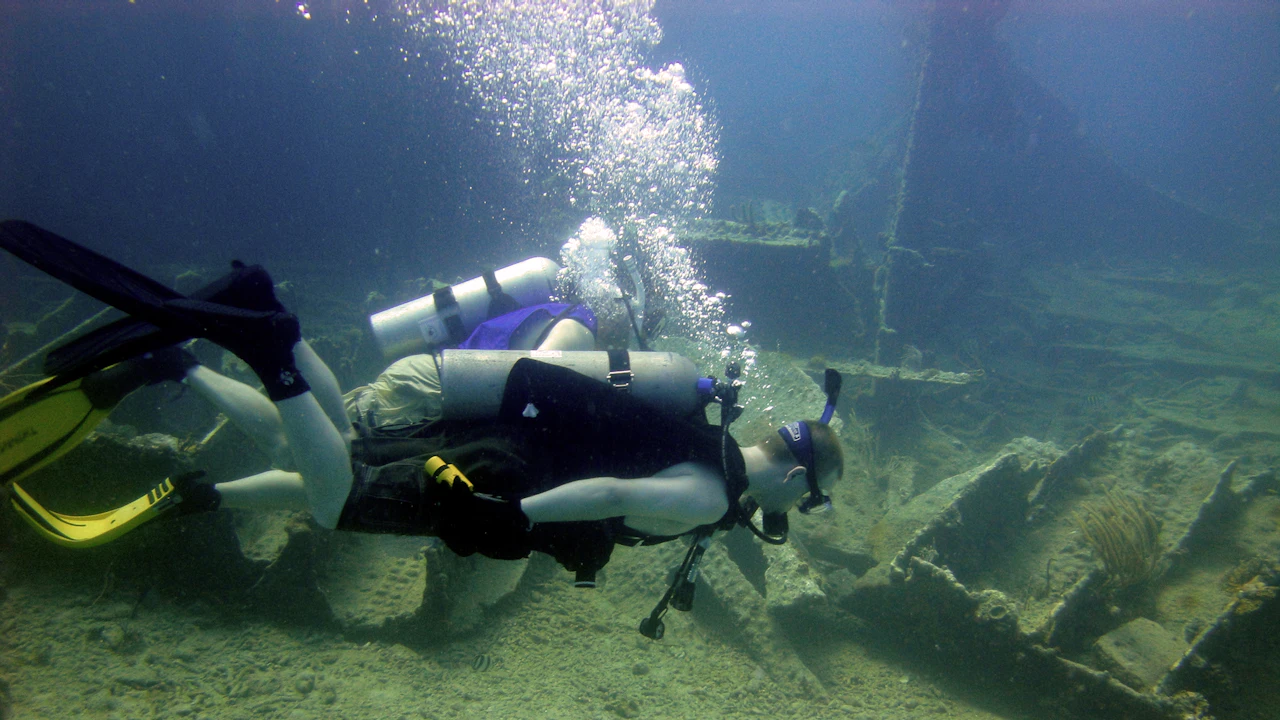
The giant stride entry is how many scuba divers get from a boat deck into the water. You stand at the edge in full gear, take one big step forward, and a moment later you are floating at the surface. It is one of the simpler skills in diving once you know the sequence.
This guide is for Open Water students, new divers and anyone who has not been on a dive boat for a while. We walk through when the giant stride is used, the steps as PADI’s own blog lists them, and why each one matters. It is a preview, not a substitute for training: you learn and practice this entry with an instructor, and on the day the crew’s instructions come first.
How do you do a giant stride entry in scuba diving?
Quick answer: Partially inflate your BCD, stand with your fin tips over the edge and scan the water below. With your regulator in, hold your console and cover your regulator and mask with one hand. Look forward, step out without jumping, make sure you float, signal okay and move clear of the entry area.
What is a giant stride entry?
A giant stride is a standing entry. You walk to the edge of a boat deck or platform, step out as if taking a long stride. Your partly inflated BCD (buoyancy control device, the jacket that holds your tank) brings you back up, and you finish at the surface ready to meet your buddy.
PADI teaches the giant stride in the Open Water Diver course. Its blog post How to Giant Stride breaks it into 11 short steps with a video, written for students who have just started the course or divers who have been out of the water for some time.

When divers use the giant stride
PADI’s guide to choosing the correct entry method calls the giant stride one of the most popular entries for deeper water from a large boat or platform. PADI’s boat diving guide adds that on hard boats (boats with a solid hull and a deck) the entry is usually a giant stride from the side or stern.
Smaller boats with low sides are a different story. There, PADI notes that a backward roll is the favorite, because sitting is easier than standing when waves make the boat pitch. Our guide to the back roll entry for scuba diving from small boats covers that method.
| Entry | Typical starting point | Your position | Why it suits |
|---|---|---|---|
| Giant stride | Large boat deck, platform, side or stern of a hard boat | Standing, facing the water | Popular for deeper water from a higher, stable deck |
| Backward roll | Smaller boat or the tubes of an inflatable | Seated on the edge, back to the water | Sitting is easier than standing when waves rock the boat |
| Controlled seated entry | Unstable platform or dock | Seated, then twisting and pushing away | For when the water is not deep enough for a giant stride |
Giant stride entry for scuba, step by step
Here is the sequence as PADI’s blog lists it.
- Partially inflate your BCD, so you float once you are in.
- Approach the entry point with your fins over the edge.
- Scan the area below for anything in the way.
- Place your regulator in your mouth and take a breath.
- Hold your console (your gauges) in your left hand, over your waist.
- Place your right palm on your regulator, with your fingers on your mask.
- Look forward, not down.
- Step out and push off. Do not jump.
- Establish positive buoyancy, so you are floating at the surface.
- Signal okay to the crew.
- Clear the area.
Before you step: air, edge and a look below
The first three steps happen before you move. PADI’s surface habits guide says to enter with a reasonable amount of air in your BCD so you float, and to add more after entry if you are not positively buoyant.
The scan matters because you are about to drop into that water. PADI’s entry guide says that although you look straight ahead as you step off, you first make sure there are no rocks or divers below. Another diver may have entered just before you.
Hands on your gear and eyes forward
Steps four to seven protect your gear. With the regulator already in and a breath taken, you are breathing from your tank from the moment you land. The console sits in your left hand over your waist, and your right palm on the regulator with fingers on the mask keeps a hand on both as you enter. PADI’s surface habits guide also says to enter the water with all gear in place, including your mask and regulator.
Looking forward rather than down is part of the PADI sequence too. Keep your eyes ahead as you take the stride, not on your feet.
The stride, then okay and out of the way
PADI’s wording is to step out and push off, and not to jump. Once you surface, make sure you are floating, signal okay, then swim clear of the entry area so the next diver can go. PADI’s boat diving guide also says to keep away from the propeller.

Boat manners that go with the stride
PADI’s guide to what to expect on a boat dive is clear on one point: never enter the water until the crew says so. It also asks divers to pay attention to the boat and dive briefings and to wait their turn when kitting up in order. Our guide to dive boat etiquette for new divers has more on sharing the deck.
Before you stand up, our pre-dive safety check with your buddy explains the buddy gear check, and once you are in, our guide on how to descend when scuba diving covers the next stage of the dive.

Learning the giant stride in training
Reading the steps is a good start, but the giant stride is a skill you learn hands-on. In the PADI Open Water Diver course your instructor shows you the entry, watches you do it and corrects your form. Our PADI Open Water course on Ambergris Caye page explains the course, and our guide to learning to dive on Ambergris Caye shows every step from first lesson to certification.
Learn with Elbert
White Sands Dive Shop is a 5 Star PADI Dive Facility on the beach in San Pedro, owned and operated by PADI IDC Staff Instructor Elbert Greer. Daily diving, SCUBA instruction and snorkeling are part of every day at the shop.
Vivake K. Bhalla wrote that Elbert “was an outstanding instructor with a lot of experience and useful tips.” Read more in the letters from Elbert’s dive students, and see current course prices on our Water Sports page.
Giant stride entry scuba: your questions answered
Should my BCD be inflated for a giant stride?
Partially, yes. PADI’s giant stride sequence starts with partially inflating your BCD, and after you land you establish positive buoyancy so you float at the surface.
Do you jump off the boat on a giant stride?
No. PADI’s wording is to step out and push off, and not to jump. Keep looking forward, not down, as you step.
When is a giant stride used instead of a back roll?
PADI describes the giant stride as a popular entry for deeper water from a large boat or platform. The backward roll is a favorite on smaller boats, where sitting is easier than standing when waves rock the boat.
What do I do right after a giant stride entry?
Make sure you are floating, signal okay to the crew, then clear the area so the next diver can enter. Keep away from the propeller.
Can I learn the giant stride from a guide like this?
A guide helps you picture it, but it is not a substitute for training. You learn and practice the giant stride with an instructor in the PADI Open Water Diver course, and you follow the crew’s instructions on every boat.
Ask us before your first boat dive
Nervous about stepping off a boat, or planning your Open Water course? Email Elbert at elbertgreer@fastmail.fm or call 011 (501) 226 2405, and we will answer your questions before you arrive.