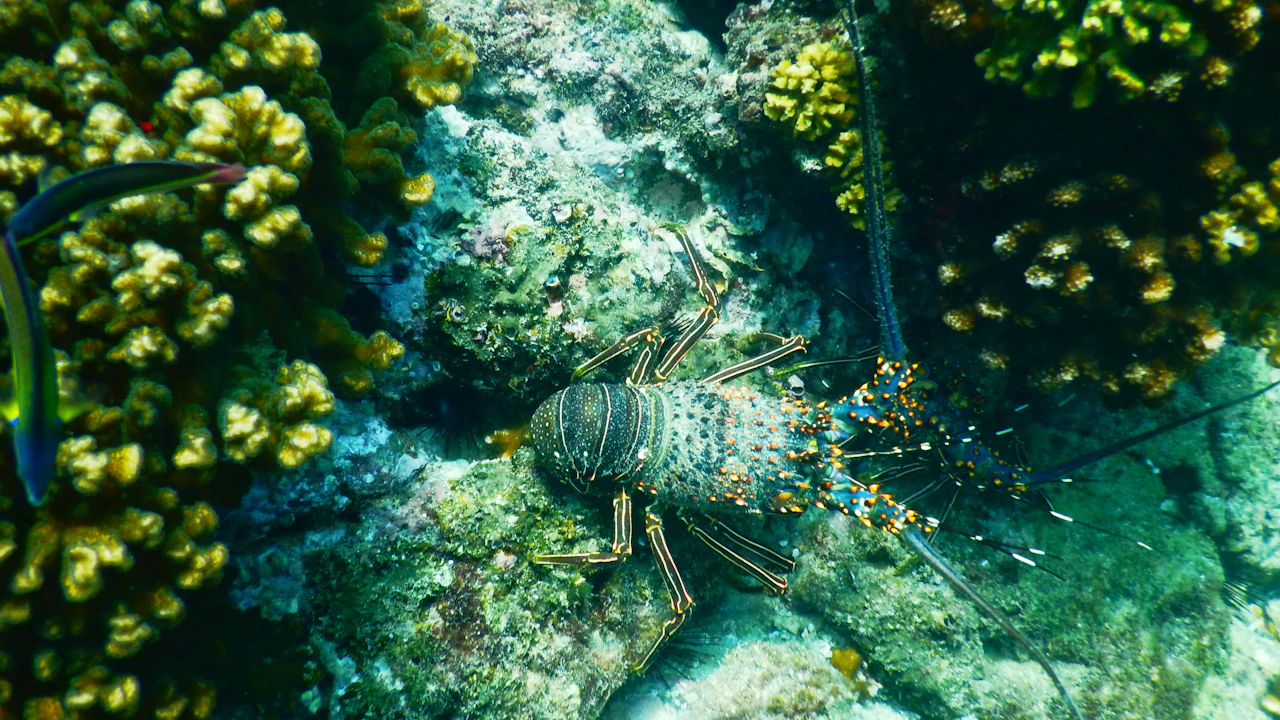
The Caribbean spiny lobster is one of the reef animals our divers ask about most. By day you usually see only a pair of long, spiky antennae waving from under a ledge. After dark the whole animal comes out, walking across the reef in plain view.
This guide is for divers and snorkelers who want to know what they are looking at: how this lobster is built, where it hides, why it moves at night, and what the rules on lobster season in Belize say. We are a dive shop, so the biology here comes from NOAA Fisheries and the season dates from the Belize Fisheries Department.
What is a Caribbean spiny lobster, and where can divers see one?
Quick answer: It is a clawless lobster covered in forward-pointing spines, with long horn-like antennae. NOAA Fisheries says it shelters in reef crevices, burrows and dens by day and forages at night. Divers usually spot the antennae under ledges in daylight and see the whole lobster walking in the open on night dives.
Spiny lobster facts: how to recognize one
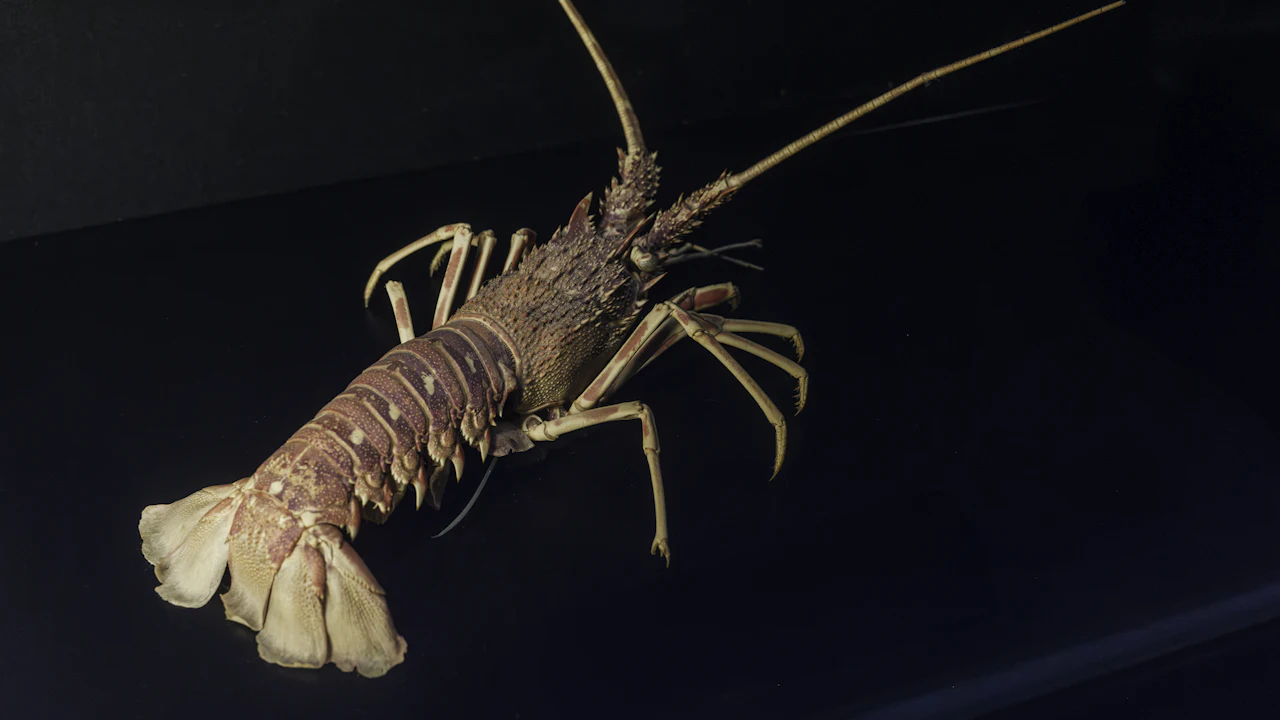
According to the NOAA Fisheries species profile of the Caribbean spiny lobster, the animal is named for the forward-pointing spines that cover its body and help protect it from predators. Unlike the American lobster, it has no large front claws. If you picture the lobster on a New England menu, this one looks quite different.
- Shell: reddish brown, sometimes with dark spots, and two large cream-colored spots on the second tail segment.
- Antennae: long, horn-like antennae over the eyes, which the lobster waves to warn off predators.
- Antennules: a smaller pair that senses movement and picks up chemicals in the water.
- Size: NOAA says they can grow up to 15 pounds and 18 inches.
NOAA also notes that the lobster grows by molting. It molts about 25 times in its first 5 to 7 years, then about once a year. Spiny lobsters may live 15 years or more, although NOAA points out that ageing them is difficult.
Where spiny lobsters live: reefs, dens and seagrass
NOAA lists a range from North Carolina to Texas, Bermuda, the whole Caribbean Sea and south to Brazil. The lobsters live in shallow water down to about 295 feet, and occasionally deeper. Where a lobster lives depends on its age, which is why you find small ones and big ones in different places.
| Life stage | Where NOAA says it lives | What it eats |
|---|---|---|
| Larva | Floating in the open water column | Soft-bodied plankton |
| Small juvenile | Dense vegetation, especially macroalgae | Plankton at first, then small prey as a carnivore |
| Larger juvenile | Crevices in large sponges, soft corals and solution holes | Snails, crabs and clams |
| Pre-adult | Shallow nearshore banks | Snails, crabs and clams |
| Adult | Bays, estuaries, coral reefs and offshore habitats; soft bottom and seagrass during migration | Snails, crabs and clams |
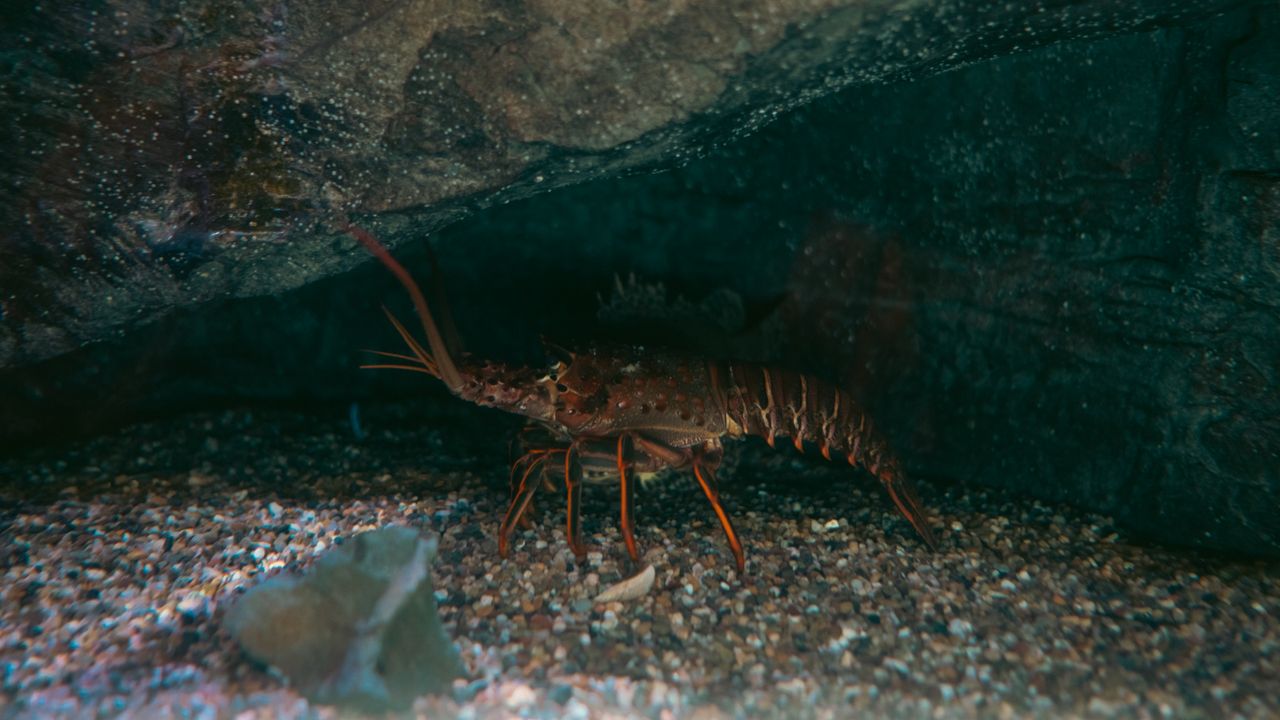
Adults spend the day tucked into coral reefs, burrows and dens. On a daytime dive, look under overhangs and into cracks in the reef. The antennae usually stick out well before you see the body.
The lobster is part of a busy food web. NOAA names groupers, snappers, sharks, skates, sea turtles and octopuses as predators of juveniles and adults. Our guide to the Nassau grouper and its spawning aggregations covers one of those predators, and our overview of marine life you can see around Ambergris Caye introduces the rest of the reef cast.
Night activity and the famous lobster queues
NOAA describes spiny lobsters as nocturnal: they shelter by day and forage at night. That makes darkness the best time to watch one behave naturally. You may see a lobster walking over sand or rubble, feeling ahead with its antennae as it hunts for snails, crabs and clams.
If you want to see this for yourself, our guide to night diving on Ambergris Caye explains how a night dive works and what to bring. Our homepage lists a night dive among the local trips; a dive light is not included, and our guide on how to choose a dive light for night diving can help you pick one.
Single-file migration
NOAA reports that adults move along the coast and offshore with the seasons, migrating in single-file lines to deeper water to escape cold and cloudy water. It is one of the stranger sights in the ocean: a line of lobsters walking nose to tail across the bottom. NOAA does not say where or when this happens off Ambergris Caye, so we cannot promise you will see it.
Breeding: eggs, larvae and berried females
NOAA says spawning happens year-round in the Caribbean. The male leaves sperm packets on the underside of the female, and she fertilizes her eggs as she releases them. A single spawn can hold roughly 230,000 to 2.6 million eggs, depending on her size.
The female carries the eggs under her tail until they hatch, in about three weeks. A lobster in this state is called “berried”. The larvae then drift in the open water before swimming to nearshore nurseries, and NOAA notes that most larvae found in US waters come from upstream sources in the Caribbean.
Lobster season in Belize and fishery status
NOAA tracks four US stocks. It reports that the Puerto Rico stock is subject to overfishing but not overfished, the Virgin Islands stocks around Saint Thomas, Saint John and Saint Croix are neither, and the South Atlantic and Gulf stock is not subject to overfishing, with its population status unknown. NOAA does not assess Belize waters.
In Belize, the Fisheries Department sets the season. In a February 2025 public notice, the department said the closed season for spiny lobster runs from March 1 to June 30 every year, and that possession of lobster during the closed season is strictly prohibited. The San Pedro Sun reported that the 2025 to 2026 season ran from July 1 to February 28.
- Closed season: March 1 to June 30, when no one may possess lobster.
- Open season: from July 1, under the Fisheries Department’s regulations.
- During the 2025 to 2026 season, the San Pedro Sun reported that rules restricted the harvest of soft-shelled, egg-bearing and black-chested lobsters.
For divers, the simplest approach is to enjoy lobsters as wildlife. Look, take photos, and give them room. Our guide to the queen conch in Belize covers another reef animal that people often ask about.
Diving with White Sands Dive Shop
White Sands Dive Shop is a 5 Star PADI Dive Facility on the beach in San Pedro, owned and operated by PADI IDC Staff Instructor Elbert Greer. Our local trips leave at 9:00, and our guide to diving Ambergris Caye on the barrier reef explains the options. You will find trip details and current dive and course prices on our Water Sports page.
Students value a calm, patient instructor. After a refresher course, Minette Layne wrote that “you really calmed me down and set me up for a wonderful couple of weeks of diving and snorkeling.” You can read the full letter and others in the letters from Elbert’s dive students.
Caribbean spiny lobster: your questions answered
Does the Caribbean spiny lobster have claws?
No. NOAA Fisheries notes that, unlike the American lobster, it lacks large front claws. It relies on its spines and long antennae for protection.
What does a Caribbean spiny lobster eat?
NOAA says juveniles and adults are carnivores that prey on snails, crabs and clams. Larvae and very young lobsters feed on soft-bodied plankton.
When is lobster season in Belize?
The Belize Fisheries Department says the closed season runs from March 1 to June 30 every year, and possession of lobster is prohibited during that time. The season reopens on July 1.
How long do spiny lobsters live?
NOAA says spiny lobsters may live 15 years or more. It adds that the estimate is uncertain because the species is hard to age.
When is the best time to see a spiny lobster on a dive?
Spiny lobsters forage at night, so a night dive is the best chance to see one walking in the open. By day, look for antennae sticking out from under ledges and crevices.
Plan your reef dives with Elbert
Want to look for lobsters on a day or night dive? Get in touch and Elbert will help you plan your diving. Email elbertgreer@fastmail.fm or call 011 (501) 226 2405.