
You planned the trip for months, and the day before your first dive you wake up sniffling. Scuba diving with a cold is one of the most common questions we hear, and the honest answer is usually “not today”. A stuffy nose may feel minor on land, but it changes how your ears and sinuses handle pressure underwater.
This guide is for divers and students who feel a cold coming on before or during a trip. We explain why congestion blocks equalizing, what a reverse block is, why decongestants carry their own risk, and when to sit a dive out. It is general information, not medical advice: for your own situation, talk to a doctor, ideally one who knows diving.
Is scuba diving with a cold safe?
Quick answer: Divers Alert Network (DAN) says it is always best not to dive with a cold. Congestion can stop you equalizing your ears and sinuses on the way down, and trap air on the way up, causing a reverse block. Wait until the congestion has cleared and you can equalize easily, and ask a doctor about any medication.
Why a cold makes equalizing hard
As you descend, water pressure squeezes the air spaces in your middle ears and sinuses. You equalize by letting air in through small passages: the Eustachian tubes to your ears and tiny openings to your sinuses. Our guide on how to equalize your ears when scuba diving covers the techniques.
A cold swells the lining of those passages and fills them with mucus. According to the DAN guide to sinus barotrauma, the sinus openings can easily be blocked by colds or allergies. When air cannot get in, the pressure difference injures the tissue, which is called barotrauma.
DAN’s prevention advice includes learning and using proper equalization techniques, and that matters even when you are healthy. With a cold, though, good technique cannot open a passage that is swollen shut. If you already feel fullness, pressure or pain in your sinuses before the dive, DAN says to refrain from diving.
The reverse block: trouble on the way up
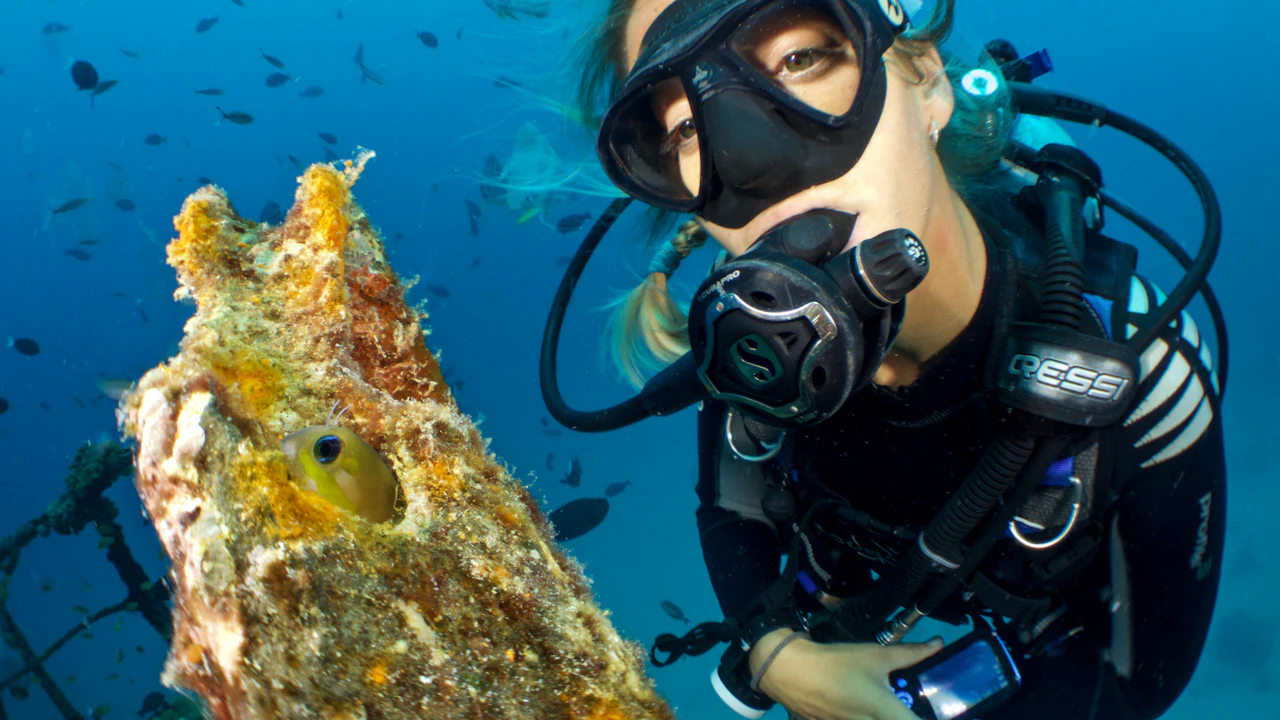
Most divers know about ear trouble on descent. Fewer know that it can happen on ascent too. DAN calls this a reverse block: as you rise, the air in your ears or sinuses expands and needs to get out, but swollen passages trap it, along with mucus and sometimes blood.
A reverse block is harder to deal with than a descent problem. On the way down, you can stop, rise a little and try again, or end the dive. On the way up, you still have to reach the surface, and your air supply is limited. DAN lists sharp facial pain during descent or ascent as the most common sign of sinus barotrauma, and blood in the mask after surfacing is common.

Decongestants and diving: what DAN says
Plenty of divers reach for a decongestant to push through. DAN is cautious about this. In its article on diving while taking medication, it tells divers to consider the possibility of the medication wearing off at depth.
That is the core risk. A decongestant can open your passages enough to get down, then fade while you are underwater. The congestion returns, the trapped air cannot escape, and you face a reverse block on ascent. DAN also warns that repeated use of short-acting nasal sprays can cause a rebound reaction that may set the stage for a reverse block.
- DAN says a diver should not be at increased risk of barotrauma because of congestion.
- It advises having experience with a drug on land before diving with it.
- Which product, dose or timing is right for you is a question for your doctor, not for us.
When to skip a dive with congestion
DAN’s guidance is short: do not dive when congested, and do not dive until swelling has gone down and you can equalize properly. The table below sets out how that applies to common situations. If you are unsure, sit the dive out and check with a doctor.
| How you feel | What DAN’s guidance points to | Sensible next step |
|---|---|---|
| Stuffy nose, hard to clear ears on land | Do not dive when congested | Skip the dive and rest |
| Fullness, pressure or pain in the sinuses | Refrain from diving with these symptoms | Skip the dive; see a doctor if it persists |
| Only feel clear after a decongestant | Consider the medication wearing off at depth | Ask a doctor before diving |
| Ears will not clear during descent | This is the time to abort the dive | Signal your buddy and end the dive |
| Cold gone, ears clear easily | Dive once swelling has resolved and you can equalize | Start with an easy, shallow first dive |
Be honest on your scuba diving medical questionnaire too. It asks about ear and sinus conditions for exactly this reason, and a yes may mean a doctor’s sign-off before you dive.

Protecting the rest of your trip
Missing one day hurts, but an ear injury can keep you out of the water for the rest of the trip. Tell your instructor or guide early, before the boat leaves, so the plan can change. Use the rest day for something dry and easy on your ears. Once you feel better, try a gentle equalizing test on the surface before you book your next dive.
Ears have other ways to spoil a trip as well. Our guide to swimmer’s ear after diving covers another common ear complaint on dive trips. When you are ready to get back in, our guide to diving on Ambergris Caye covers the daily reef dives.

Diving with Elbert
White Sands Dive Shop is a 5 Star PADI Dive Facility on the beach in San Pedro, owned and operated by Elbert Greer, PADI IDC Staff Instructor. If you are feeling unwell, tell him as early as you can.
Students often mention how he puts nervous divers at ease. Susan wrote: “You truly put me at ease and made the whole experience fun.” Read more in our letters from students Elbert has taught.
Scuba diving with a cold: your questions answered
Can I scuba dive with a stuffy nose?
DAN says it is always best not to dive with a cold or any condition that may block the sinus passages. Wait until you can equalize easily without effort.
Can I take a decongestant and dive?
DAN advises considering the possibility of the medication wearing off at depth, which can lead to a reverse block on ascent. Ask a doctor, ideally one who knows diving, before diving on any medication.
What is a reverse block?
A reverse block happens on ascent, when expanding air cannot escape from the ears or sinuses because the passages are swollen. DAN notes that colds and allergies can cause this.
How long after a cold can I dive?
DAN says not to dive until swelling and inflammation have resolved and you can adequately equalize. There is no fixed number of days, so check with a doctor if you are unsure.
What should I do if my ears will not clear on descent?
Stop, rise a little and try again gently. If you still cannot equalize, DAN says this is the time to abort the dive, so signal your buddy and end it.
Talk to us about your dive plans
Feeling under the weather before a dive, or want to plan around a cold? Email Elbert at elbertgreer@fastmail.fm or phone 011 (501) 226 2405. Let us know how you feel and when you arrive, and we will talk through your options.